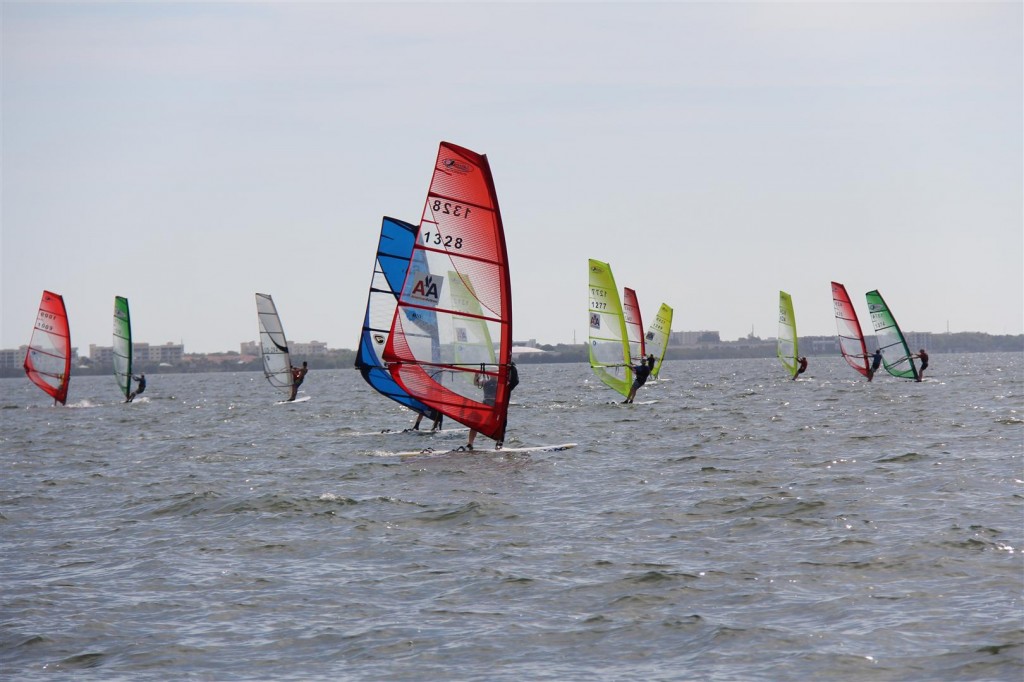
Early History of Windsurfing, From the Twin Cities to Worldwide
Merely a crazy idea in early 1967, the first production Windsurfers hit the market in late ’69. Several of those boards made it back to the Twin Cities. Windsurfer Fleet #8 was formed in 1972, the same year that the first Windsurfers were shipped to Europe. Five years later, the European scene had exploded, surpassing snow skiing in gross sales, and the Twin Cities stood poised to catch that same wave of popularity.
History of Fleet 8, Host of the 2012 Kona North American Championships
Fleet 8 was reborn in 1977 with the assistance of Twin Cities/Lake Minnetonka native, Michael Fox. The sport was taking off nationally and the Twin Cities was at the forefront with the city lakes providing high visibility. The following year, Fleet 8 stepped up the pace, hosting a District Championship on Lake Waconia and starting an Aquatennial event that would bring thousands of spectators to the shores of Lake Calhoun, year after year. But what was to become the fastest-growing market in the western hemisphere was threatened when the DNR tried to put the brakes on. They refused to recognize the Coast Guard’s PFD exemption. Fortunately, Fleet 8 convinced the Hennepin County Sheriff and Minneapolis Park Police to honor the CG exemption until they had the chance to rectify the situation. It really brought the windsurfing community together for the cause and after nearly three years pushing a bill, Minnesota became the first state (many states never had to confront this issue) to pass legislation for a state exemption. In retrospect, while it really helped gel the Fleet 8 community, it also helped protect the fun environment, a significant factor in the growth of the sport.
The 1980’s, the Sport Continues to Grow, but also Starts to Evolve.
Celebrating the legislative victory, the 1982 Fleet 8 schedule consisted of three long-distance races, eight regattas, the Aquatennial and 18 evening races split between three series on Lake Calhoun, Lake Minnetonka and White Bear Lake. Fleet 8 continued to promote one-design racing with the Windsurfer, and later with the Mistral Superlight. But there were so many other boards looking to race. The phenomenal growth in Europe had created over 100 different sailboard manufacturers and the Twin Cities had as many as twenty retailers. Fleet 8 added an Open division to their races and for several years hosted both a One-design State Champs and an Open State Champs. But at the same time, the industry was shifting its marketing focus away from the race course and on to the waves of Hawaii and the extreme conditions of the Gorge in Oregon.
Mille Lacs Crossing, 1982 – 2009; The Premiere Long Distance Event of North America.
In August of 1982, Fleet 8 started developing the first Mille Lacs Crossing. Attendance quickly grew from a 35 invitation-only event the first year to 125-plus in the fourth year and for four years after that. While Fleet 8 continued to learn and implement changes, the 1993 Crossing clearly defined the high level of potential risk. Maintaining this highly popular event safely demanded energy and focus. Without the entry-level support of one-design, the course racing scene eroded, going from 7 events down to just one event on Waconia. The Crossing had been built off the popularity of racing, so it also was showing the effects of decline. In 2009, Fleet 8 was forced to terminate the longest running and one of the most popular events in windsurfing history.
Year 2010, Kona One-Design Brings Hope
In November, 2010, Michael Fox joined several Midwest racers in Miami to experience the Kona Worlds. It was like time travel back to the 80’s. Over the winter, Michael teamed with Brad Woodworth of Dryden, ONT and Steve Callaway from Iowa to create a game plan for introducing Kona One-design to the Midwest race scene. And it was an awesome season. They were able to provide charter boards which allowed for two dozen different Kona racers over six different regattas. One design racing was back strong and inspired the drive to host the 2012 Kona North Americans.